
In the oleochemical industry chain, fatty acids are one of the most fundamental and widely used bulk chemicals. They are found everywhere—from surfactants and rubber additives to coatings, lubricants, and cosmetics. The starting point for all of this is a well-designed, efficiently operated fatty acid production line.
Unlike fatty alcohol production, which relies on hydrogenation, the mainstream industrial route for fatty acids is continuous high-pressure hydrolysis. This process “splits” triglycerides into fatty acids and glycerol by reacting natural fats and oils with water under high temperature and pressure. The efficiency and product purity of this route depend on the synergy of three core sections: hydrolysis, distillation, and evaporation.

High-Pressure Hydrolysis: Conversion Rate Determines Output
The “heart” of fatty acid production is the high-pressure continuous hydrolysis tower. Here, pre-treated oils and fats are brought into counter-current contact with high-pressure hot water at 250-260°C and 5.0-6.0 MPa, completing the hydrolysis reaction in the presence of a catalyst.
The key performance indicator for this process is a hydrolysis rate exceeding 98%, which directly determines raw material utilization. Crude fatty acids are drawn off from the top of the tower, while the glycerol-rich “sweet water” is extracted from the bottom for recovery and treatment.
The technical challenge lies in ensuring long-term stable operation of equipment under these severe conditions, preventing thermal degradation of fatty acids, and achieving efficient heat recovery. This is the core challenge in the design of modern fatty acid production lines.
Distillation and Refining: The Critical Role of the Thin-Film Evaporator
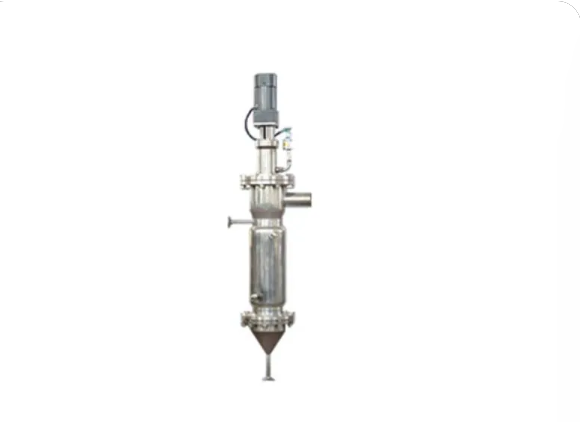
Crude fatty acids contain impurities such as unreacted glycerides, polymers, and pigments, which must be removed through a high-vacuum distillation system. The core equipment in this section is the Thin-Film Evaporator.
The advantage of the Thin-Film Evaporator lies in its extremely short material residence time. The material is evenly distributed as a turbulent thin film over the heated surface, allowing rapid evaporation under high vacuum. This design effectively prevents the thermal degradation and discoloration of heat-sensitive fatty acids that would occur with prolonged heating. This is crucial for producing high-quality products such as light-colored, low-thermal-damage oleic acid.
The distillation system can be optionally equipped with a fractionating column to further separate mixed fatty acids into high-purity, single-component products like C16 palmitic acid or C18 oleic acid, thereby diversifying the product range.
By-Product Glycerol Recovery: The Energy-Saving Logic of Multi-Effect Evaporation
The glycerol in the “sweet water” (typically 12-20% content) is an important co-product of the production line. Recovering it requires multiple purification and concentration steps. The core equipment for this is the Multi-Effect Evaporator, which operates by cascading the vapor from one effect as the heating source for the next, achieving tiered heat utilization, typically in a three- or four-effect configuration.
Compared to traditional single-effect evaporation, a multi-effect evaporation system can reduce steam consumption by more than 30%, making it a key technology for energy-efficient operation in modern fatty acid plants. The concentrated crude glycerol is then further purified through vacuum distillation to produce refined glycerol with a purity of ≥99.5%, which is an important industrial chemical.
Feedstock Flexibility: From Fats and Oils to PFAD
A well-designed fatty acid production line must have broad feedstock adaptability. It should be able to process a wide variety of raw materials, including beef tallow, mutton fat, palm oil, Palm Fatty Acid Distillate (PFAD), soybean oil, rapeseed oil, sunflower seed oil, corn oil, used cooking oil (UCO), acidulated oil, and more.
This flexibility allows producers to switch between feedstocks based on market prices and availability, optimizing production costs and ensuring operational stability.
Zhengzhou Ocean offers customized fatty acid production lines based on core technologies of high-pressure continuous hydrolysis, thin-film evaporation, and multi-effect evaporation. From engineering design to equipment manufacturing, our solutions balance high conversion rates, product flexibility, and energy efficiency to help clients compete in the global oleochemical market.