
For electronics repair shops, a precision screwdriver kit is more than a tool purchase. A poorly matched set can slow technicians down and leave them searching for a suitable tip mid-repair. Buyers should look beyond piece count and assess bit coverage, reach, handling, accessories, and supplier capacity.
Jakemy supplies precision tools and offers OEM/ODM services, making its range relevant to repair businesses, distributors, and retailers. These criteria can help buyers decide whether a kit suits their service mix and purchasing plans.

Start with the repair mix, not the number on the box
A shop replacing laptop batteries and fans has different needs from one focused on smartphones, tablets, game consoles, cameras, or small appliances. A screwdriver set for laptop repair should match the fastener types and sizes technicians encounter, rather than simply advertise a high piece count.
Useful profiles may include Phillips, slotted, Torx, security Torx, hex, tri-wing, triangular, square, and U-shaped types. A broad selection can reduce switching between kits, but only when sizes match the devices being serviced. Request a detailed component list before ordering; it also supports technician training and fair product comparisons.
Check bit coverage and material information
Repeated use can wear tips, while an ill-fitting bit may slip and damage a screw head. Buyers should review steel types, surface treatment, and replacement-bit availability. Material labels alone do not determine service life; dimensions, manufacturing quality, fastener condition, and technique also matter.
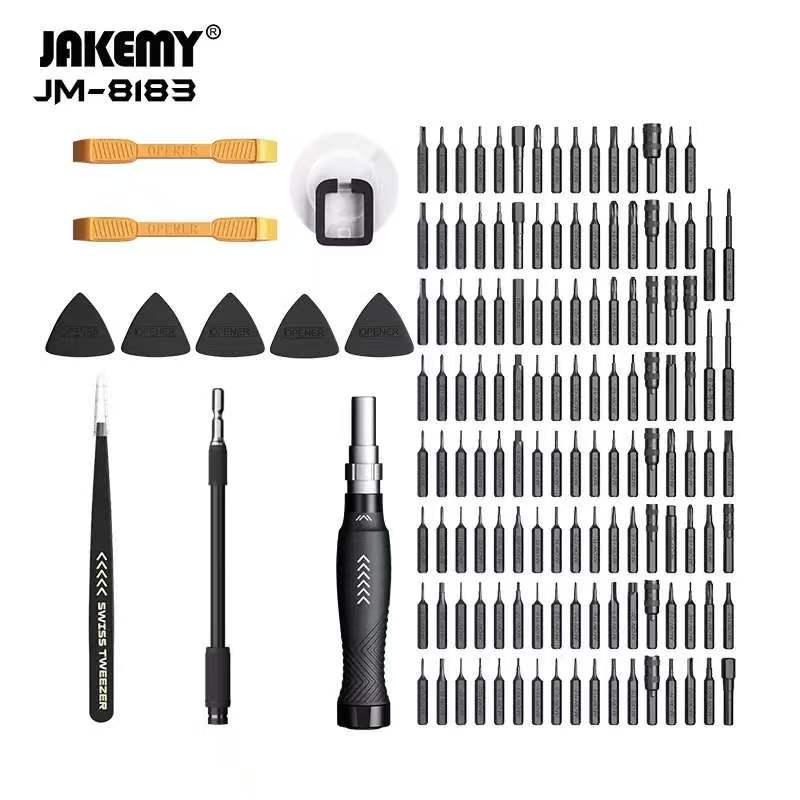
The jm-8183 is listed as a 145-piece precision screwdriver set with 132 screwdriver bits. The official page identifies CR-V and S-2 as bit materials and lists four 45 mm deep-hole bits made from S-2 chromium-molybdenum steel.
These longer bits can help reach recessed fasteners in some electronics and appliance assemblies. Listed profiles include Phillips, slotted, Torx, security Torx, hex, tri-wing, triangular, square, and U-shaped types, among others.
Compare the component chart with the sizes technicians use most before committing to a volume order.
Assess reach and control at the bench
Small screws can be awkward to reach around laptop hinges, cooling assemblies, and narrow internal compartments. Handle texture, cap design, and extension options affect comfort and control. A rotating cap can help technicians turn small fasteners with fingertip control.
The manufacturer lists the JM-8183 with a three-dimensional anti-slip handle texture and a built-in adjustable extension that reaches up to 50 mm. The accessories also include a separate 130 mm extension bar. Buyers should distinguish these components when checking the configuration and consider which is more useful for their routine jobs.
Technicians should use a well-fitting bit, keep it aligned with the screw, and apply controlled pressure rather than forcing the fastener. A kit does not replace safe disassembly procedures or electrostatic-discharge precautions for sensitive electronics.
Review storage and accessory practicality
In a busy repair station, storage affects how easily technicians return parts and notice missing items. Dedicated sections and legible markings can make it easier to select a size and reset the kit after a job.
The official listing describes a diamond-cut case, organized storage sections, and laser-engraved bit markings. Buyers should check whether the layout is clear to staff with different experience levels.
Listed accessories include a suction cup, spudgers, tweezers, ultra-thin opening tools, and an extension bar. These can support housing separation, screen lifting, and small-component handling, depending on the device and procedure.
Check whether the accessories suit the work performed, can be replaced, and duplicate tools already in the shop. Opening tools need careful use, since forcing a seam may damage clips, cables, or panels.
A short bench trial is often more useful than a desk-only review. Ask technicians to locate common bits, perform a sample task, and repack the set afterwards.
Confirm the commercial details
For professional buyers, minimum order quantity, packaging, lead time, quality inspection, spare-part availability, and private-label options can affect order value.
The manufacturer lists the JM-8183 in black, measuring 184 × 106 × 45 mm, with a gross weight of 0.7014 kg per set, CE certification, and OEM/ODM service. The stated minimum order quantity is 100 pieces.
Carton packing is listed as 20 sets per carton, with carton dimensions of 40.5 × 27.5 × 30 cm and gross carton weight of 14.85 kg. Confirm current specifications, documentation, and shipping details in the quotation because product information may change.
The company’s supplied profile describes in-house manufacturing, more than 20 imported machines, and warehouse capacity for up to 8 million sets with inventory storage support of up to 60 days.
These details can inform supplier discussions, but buyers should still confirm stock allocation, production schedules, inspection records, and delivery terms for their order.
Match the kit to actual repair demand
The JM-8183 may suit shops seeking broad coverage for laptop and electronics maintenance, particularly where recessed screws and varied bit profiles are common. Compare its component chart with past repair tickets and test a sample before standardizing it across a team.
When evaluating a screwdriver set for laptop repair, list required profiles, test the grip and extension features, verify the accessory list, and clarify quantities and delivery arrangements. The aim is not to buy the set with the largest count, but to choose one that supports repeatable work and makes commercial sense.
With its precision-tool range and OEM/ODM options, Jakemy may also interest distributors and retailers seeking a consistent assortment or customization. Reviewing product details and confirming order terms gives purchasing teams a clearer basis for deciding whether this kit fits their business.