
Corporate training is becoming a continuous business process rather than a periodic HR activity. New software, changing customer expectations, and evolving job requirements can quickly make existing skills outdated. Traditional training pipelines often struggle to keep pace because content creation, learner assessment, course delivery, and feedback remain fragmented. AI business solutions can connect these stages, helping enterprises create more responsive learning programs while keeping training aligned with operational needs.
Why Corporate Training Pipelines Need to Change

A conventional training program often follows a fixed sequence: identify a need, develop materials, schedule sessions, deliver courses, and evaluate completion. This approach works for stable skill requirements but becomes less effective when employees need frequent updates.
IBM notes that organizations are increasingly using generative AI to create more personalized learning pathways based on employees’ roles, experience, and existing skills. AI can also support learning within the flow of work rather than separating training completely from daily responsibilities.
For large enterprises, this creates an opportunity to redesign training as an ongoing pipeline. Instead of delivering identical material to every employee, organizations can provide learning resources according to role, skill gaps, business priorities, and individual progress.
Turning Enterprise Knowledge into Training Content
One of the biggest barriers to effective internal training is the distribution of enterprise knowledge. Policies, product documentation, process manuals, technical specifications, project records, and operational guidelines may exist across different systems.
Generative AI can help employees interact with this knowledge more naturally. Rather than searching through multiple repositories, learners can ask questions and receive contextual explanations. However, enterprises still need to control which information models can access and how sensitive data is handled.
That makes AI business solutions particularly valuable when they can connect AI capabilities with governed enterprise data. A training assistant can then become more than a generic chatbot: it can support learning with information that reflects the organization’s actual processes and terminology.
Personalizing Learning at Enterprise Scale
A major advantage of AI-enabled training is personalization. Employees performing different jobs rarely need exactly the same learning pathway. A sales representative, software engineer, production manager, and compliance specialist may require different examples, exercises, and levels of technical detail.
AI can help generate or recommend content according to these differences. McKinsey highlights the importance of scalable and personalized learning, including AI-enabled coaching that supports employees during their everyday work.
This does not mean removing human instructors. Instead, AI can handle repetitive preparation and provide individualized support, allowing learning and development teams to concentrate on curriculum strategy, coaching, and organizational capability building.
Connecting Training with Business Systems
The next step is connecting learning with the systems employees already use. A training platform that exists separately from enterprise applications can create friction because employees must constantly switch between tools.
An advanced AI business solution can bridge this gap through integrations with enterprise applications and services. For example, an AI agent could explain a workflow, retrieve approved internal information, guide an employee through a process, or help summarize lessons learned after completing a task.
This approach makes training more actionable. Employees do not simply learn a concept and return to work; they can apply that knowledge directly within the business context.
Security Cannot Be an Afterthought
Corporate training can involve sensitive information, particularly when employees learn from internal policies, customer-related materials, technical documents, or proprietary processes. Generative AI therefore introduces governance questions alongside productivity opportunities.
McKinsey identifies privacy, intellectual property, security, inaccurate outputs, and governance as important considerations when enterprises deploy generative AI. It also recommends appropriate training for end users as part of responsible implementation.
For this reason, enterprises evaluating AI business solutions should examine data access, model governance, deployment controls, and integration architecture alongside user experience.
LocalGPT and Enterprise AI Enablement
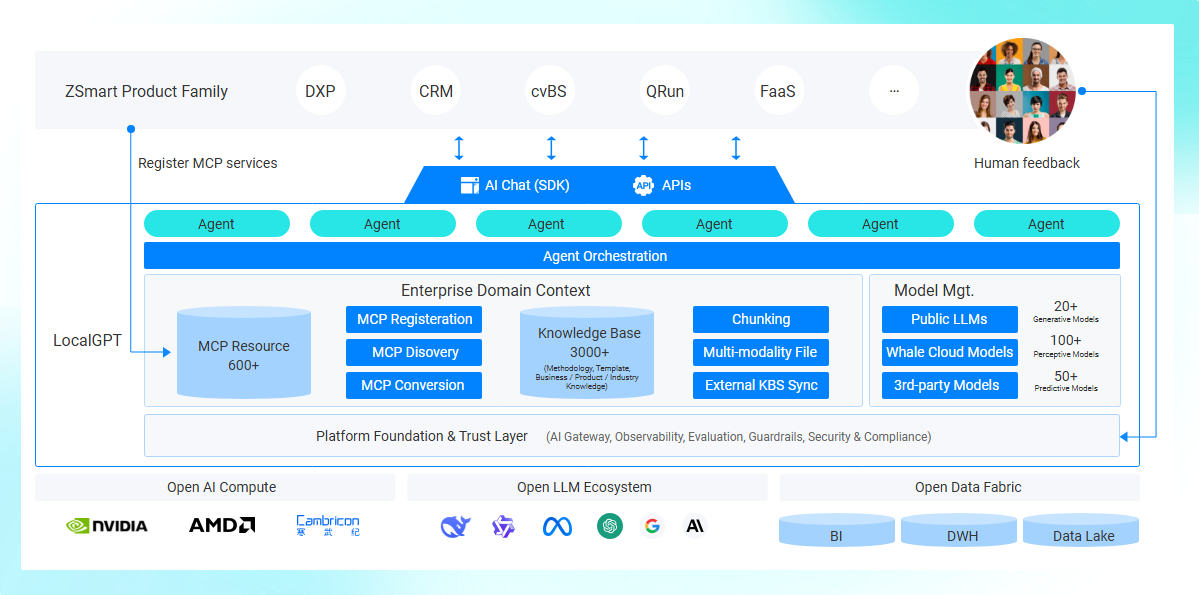
Whale Cloud’s LocalGPT addresses this enterprise requirement as an enterprise-level GenAI application development platform built around security, flexibility, and professional deployment. Its multi-model compatibility is designed to support different enterprise AI requirements while keeping data sovereignty as a core consideration.
The platform also uses low-code capabilities for agent orchestration and connects GenAI with enterprise data through EDC. Its MCP services enable large models to interact with enterprise business systems, creating a foundation for applications that can combine knowledge retrieval, AI reasoning, and operational workflows.
For corporate training, these capabilities can support use cases such as internal knowledge assistants, role-specific learning agents, interactive policy training, and AI-supported workplace guidance. The value lies in connecting training with the enterprise environment rather than treating learning as an isolated application.
Building a Continuous Learning Pipeline
Enterprises should ultimately measure training by capability gained rather than course completion alone. An effective pipeline can connect skill requirements, content generation, personalized learning, workplace application, and feedback into a continuous cycle.
That model allows organizations to update training as business processes change. It can also help learning teams identify recurring knowledge gaps and determine where additional human instruction is needed.
Moving Corporate Learning Toward Intelligent Workflows
AI is unlikely to replace the strategic role of corporate learning teams. Instead, it can remove repetitive work and make learning more responsive to individual and business needs. The strongest AI business solutions will connect trusted enterprise knowledge, personalized training, workflow assistance, and governance within one practical architecture.
Whale Cloud provides digital and intelligent capabilities for telecommunications and enterprise customers, while LocalGPT provides a foundation for developing secure, flexible GenAI applications connected to enterprise data and systems. Whale Cloud helps businesses explore practical AI adoption strategies and identify suitable solutions for their digital transformation needs.