
What happens when a dental lab prints twenty crown models overnight, only to discover the next morning that half of them seat tightly while the rest fall short along critical cervical margins? In commercial dental production, dimensional inconsistency is more than a minor headache—it is a direct drain on technician time and laboratory profitability.
As restorative dentistry relies increasingly on intraoral scans and computer-aided design (CAD) software, physical manufacturing must match digital files down to the exact micron. Achieving this level of mechanical repeatability requires moving beyond standard liquid crystal display masking. Today, digital light projection technology sets the gold standard for high-throughput manufacturing with greatly suppressed performance drift.

The DLP Precision Advantage
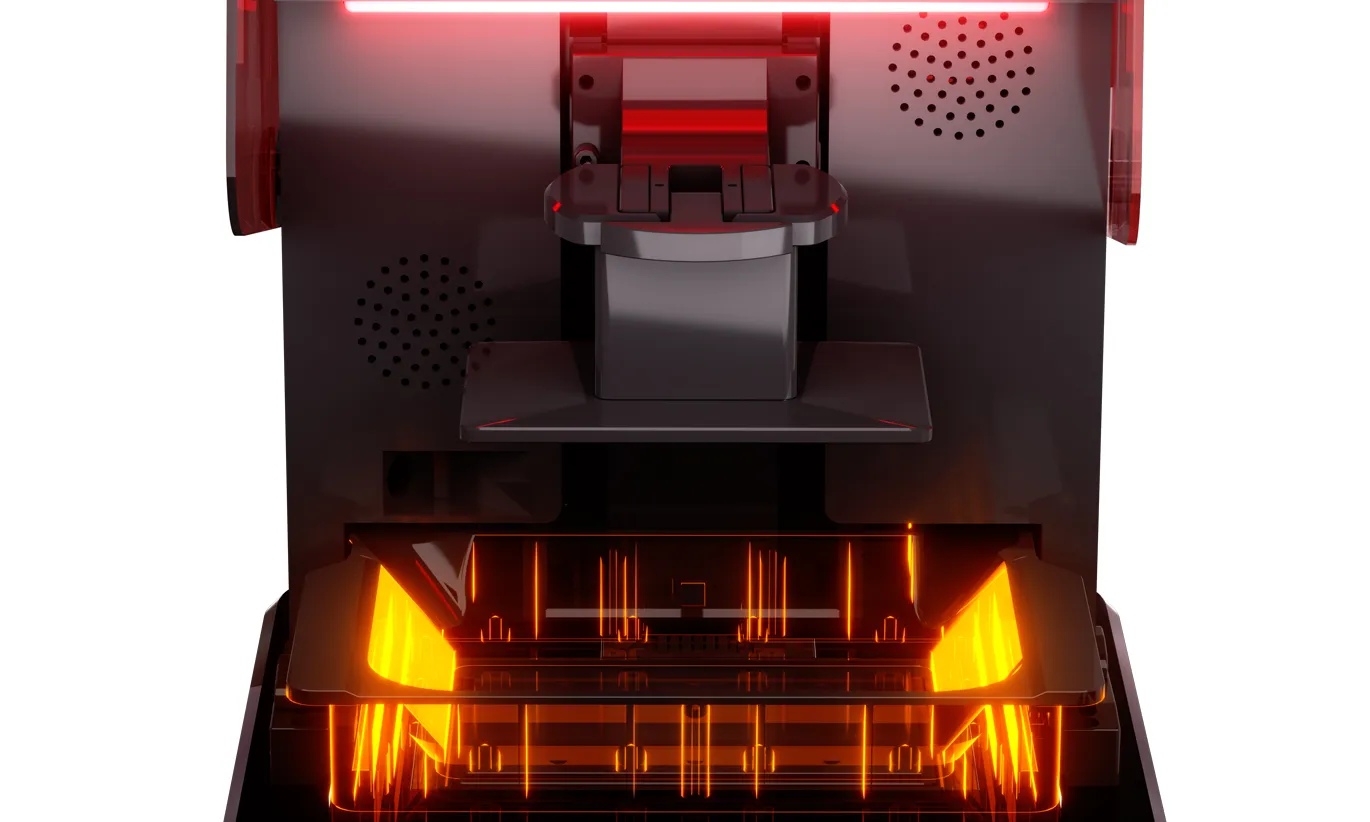
Consistent long‑term print quality relies on stable, uniform UV light delivery to cure photopolymer resin accurately. The high-performance DLP resin 3D printer uses a digital micromirror device (DMD) to project patterned ultraviolet light directly onto the resin surface. The optical engine, together with precision projection optics, delivers accurate layer images while maintaining consistent optical performance over extended operation.
Direct light reflection changes the consistency equation:
- Minimized Optical Degradation: Output intensity maintains high stability across years of daily use thanks to its professional direct-projection optical architecture.
- Sharp Pixel Boundaries: Focused projection reducesgreatly light bleed, preventing unwanted over-curing along delicate margin lines.
- Targeted 385 nm Wavelength: Concentrating energy at a dedicated 385 nanometer wavelength maximizes photopolymer cross-linking while effectively mitigating yellowing and heat-induced warping risks for precise, stable printing results.
Because light output maintains high stability, a given print job can produce highly consistent physical dimensions over extended periods.
Minimizing Edge‑to‑Edge Variance Across the Build Plate
Long-term optical stability supports part-to-part consistency over time, but spatial uniformity across a single build tray is equally vital. If light intensity fluctuates between the center of a platform and its outer perimeter, parts printed on the edges may cure differently than those placed in the middle.
Advanced projection optics mitigate this spatial variance by projecting collimated light with high uniformity across the full image plane. For a busy lab, improved spatial uniformity enables greater operational flexibility. Technicians can pack an entire build tray with die preps, full arches, and surgical guides without worrying whether a peripheral part will suffer fit discrepancies. The build plate maintains highly consistent cure depth and edge resolution across its usable area.
Built for Reliability: Riton RXDent-D130
Translating optical precision into real-world laboratory efficiency requires rugged mechanical engineering. Equipment manufactured by Riton, specifically the RXDent-D130, demonstrates how integrated hardware design maintains strict physical tolerances under continuous industrial use.
At the core of the RXDent-D130 is an industrial-grade 385 nm DLP projector rated for long-term continuous service. With adjustable output intensity spanning 4 to 12 mW/cm², lab managers can fine-tune light energy to match specific material chemistries perfectly.
Several key automated features reinforce this structural stability:
- Dual-Zone Thermal Management: Rapid internal heaters warm liquid resin up to 45°C within five minutes, maintaining constant fluid viscosity to prevent voids and reduce mechanical drag during print cycles.
- Rigid Z-Axis Guidance: A P-class ball screw drive sustains positioning accuracy within ±01 mm, protecting multi-unit restorations from microscopic layer shifts.
- Real-Time Force Sensing: High-sensitivity sensors track peel forces and release film tension throughout lift cycles, adjusting motor speed dynamically to preserve delicate green-state geometry.
- Automated Liquid Management: Continuous level monitoring automatically tops off liquid photopolymer during long runs, preventing incomplete prints or air bubble entrapment.
Practical Impact on Daily Dental Workflows
Integrating an industrial resin DLP 3D printer into daily lab operations pays immediate dividends across diverse clinical applications:
- Crown and Bridge Restorations: Precise pixel control maintains crisp internal fit parameters. Crowns glide smoothly onto die models without internal friction, eliminating hours of tedious manual grinding.
- Implant Surgical Guides: Consistent layer curing prevents distortion inside guide channels. Metal drill sleeves press-fit snugly into place, ensuring drill angles remain true during surgery.
- Castable Partial Frameworks: Resin formulations cure evenly throughout delicate clasp arms and thin lingual bars. Clean burnout leaves minimalash residue, supporting the production of smooth metal castings.
Occlusal Guards and Splints: Uniform polymerization reduces greatly micro-stair-stepping along occlusal surfaces, drastically cutting down on chairside polish time and delivering a comfortable patient fit immediately.
The True ROI of Repeatable Production
In the dental lab industry, invisible expenses often swallow profits. Every remade model, ill-fitting guide, or distorted crown burnout consumes raw material and wastes valuable technician labor.
Adopting a robust DLP resin 3D printer shifts technician effort from corrective grinding to high-value aesthetic finishing. When physical output mirrors digital CAD files with total fidelity, remakes would drop significantly, turnaround times would shrink, and clinician satisfaction would surge.
Through cutting-edge optical engines and heavy-duty chassis design, Riton equips modern dental facilities with the tools necessary to master high-volume manufacturing. Investing in projection-based precision secures predictable quality, streamlines lab operations, and establishes a solid foundation for sustainable growth.