
Procurement begins with a rigorous analysis of existing facility energy consumption patterns and daily peak demand intervals. Facility managers must audit historical utility bills meticulously to identify exactly which heavy inductive loads trigger costly monthly demand charges.
Deploying effective commercial battery storage requires matching available kilowatt-hour capacity directly against these precise operational voltage spikes. Accurate load profiling prevents expensive miscalculations during the initial hardware procurement phase.

Sizing calculations dictate the physical footprint and total capital expenditure required for the upcoming distributed energy project. Engineers evaluate the site’s photovoltaic generation curves to ensure the storage system captures all surplus afternoon electrons efficiently.
Oversizing leads to stranded capital, while undersizing leaves the building vulnerable during expensive evening tariff periods. Precise capacity modeling ensures maximum financial returns on the new electrical infrastructure.
Project developers rely on advanced data logging tools to map out baseline consumption across different seasonal operating conditions continuously. Analyzing winter heating loads versus summer cooling demands provides a realistic baseline for necessary depth of discharge parameters.
Accurate telemetry ensures the chosen hardware handles multi-megawatt transitions seamlessly without straining internal electrochemical cells. Robust baseline data forms the foundation of a resilient enterprise power strategy.
Architectural Advantages of Rack-Mounted Configurations
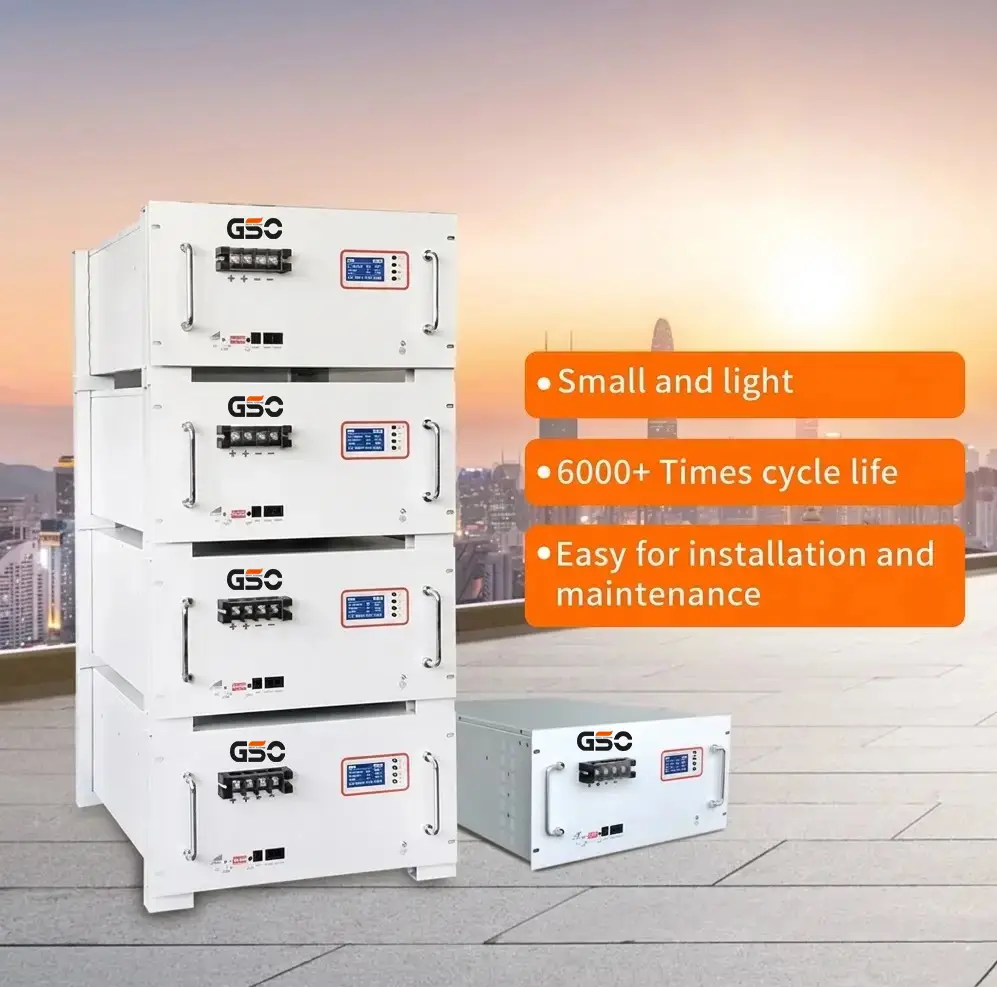
Standardized equipment topologies simplify deployment logistics significantly across diverse industrial sites and retrofitted manufacturing plants worldwide. Utilizing a rack-type setup allows installation crews to slide heavy battery modules into pre-wired metal chassis effortlessly.
GSOpower designs robust rack-mounted units that optimize vertical spatial utilization inside crowded electrical control rooms. Such modular setups reduce onsite labor costs while accelerating total project commissioning timelines.
Scalability represents a core purchasing factor for growing enterprises facing unpredictable future power demands and facility expansions. Parallel rack configurations enable incremental capacity upgrades without requiring a complete redesign of the primary electrical distribution bus.
Procurement teams secure long-term flexibility by investing in modular architecture that adapts dynamically alongside evolving business operations. Expanding total kilowatt-hour reserves becomes a plug-and-play operation for local technicians.
Lithium iron phosphate chemistry currently dominates industrial applications due to its exceptional thermal stability and multi-decade cycle longevity. Prismatic cell designs housed within these racks prevent premature capacity degradation under intense daily charge and discharge regimes.
Buyers should exclusively target LiFePO4 technology to guarantee maximum operational lifespan and minimal mechanical maintenance overhead. Modern prismatic cells deliver superior energy density without compromising localized site safety.
Communication Protocols and Hybrid Inverter Harmonization
Integrating commercial battery storage for solar demands comprehensive hardware harmonization between external photovoltaic strings and internal inverters. Buyers must verify that the selected battery management system communicates flawlessly with third-party hybrid conversion electronics.
Seamless digital handshakes prevent catastrophic overvoltage events during sudden load rejections or unexpected utility grid failures. Flawless telemetry exchange guarantees efficient energy routing during fluctuating daytime weather conditions.
System controllers utilize high-speed CAN bus or RS485 communication lines to broadcast real-time state-of-charge metrics continuously. Master processors analyze this incoming data to adjust charging parameters dynamically based on individual module temperatures and internal resistance.
Precise software coordination equalizes cell voltages actively, mitigating uneven wear across massive multi-rack electrochemical arrays. Robust digital integration extends hardware lifespan across demanding heavy industrial environments.
Grid-tie compatibility requires strict adherence to local utility codes governing frequency ride-through capabilities and automated anti-islanding protection. Inverters paired with storage banks must disconnect instantly from downed public distribution lines to protect utility repair personnel.
Selecting certified conversion hardware streamlines utility interconnection approvals significantly for regional project developers. Approved component synergy eliminates regulatory bottlenecks prior to final facility commissioning.
Mandated Safety Systems and Active Thermal Controls
Fire suppression mechanisms remain non-negotiable requirements mandated by modern commercial building codes and regional municipal safety inspectors. Heavy-duty enclosures must feature integrated aerosol extinguishers, multi-point thermal sensors, and automated off-gas detection circuitry to pass compliance.
GSOpower integrates redundant safety layers into its high-capacity cabinets to isolate anomalous cell behavior. Such rigorous protection prevents localized thermal events from propagating across adjacent hardware racks.
Cooling infrastructure dictates how well semiconductor switches and internal cells endure continuous heavy-duty industrial workloads year-round. Liquid-cooling loops or variable-speed forced air ventilation must maintain optimal core temperatures across all integrated rack modules simultaneously.
Purchasers must review ambient temperature ratings carefully to ensure the equipment survives hot mechanical rooms or harsh field climates. Aggressive thermal regulation preserves overall conversion efficiency and prevents system derating.
Fault isolation relies on ultra-fast solid-state fuses and hardware-level desaturation detection circuits embedded directly into the primary busbars. Short-circuit events trigger automated DC contactors that sever the electrical connection within milliseconds of detecting an anomaly.
Physical hardware isolation prevents catastrophic arc flashes and protects sensitive downstream automation equipment from transient voltage spikes. Industrial-grade protection features help improve operational reliability and personnel safety.
Lifecycle Cost Analysis and Procurement Finalization
Financial evaluation extends far beyond the initial purchase price to encompass total lifecycle operational expenditures over a twenty-year horizon. Enterprises calculate projected peak shaving savings and time-of-use tariff arbitrage to determine the expected break-even timeline accurately.
Implementing reliable commercial battery storage transforms passive utility expenditures into predictable, actively managed financial assets. Organizations achieve total energy autonomy while shielding themselves from unpredictable utility rate hikes.
Warranty documentation requires meticulous scrutiny regarding guaranteed throughput limits and minimum retained capacity percentages over extended timeframes. Favorable vendor agreements offer at least six thousand cycles while retaining seventy percent or more of original nameplate capacity.
Diligent buyers cross-reference these guarantee metrics against their anticipated daily cycling frequency to validate the proposed return on investment. Transparent warranty terms separate premium hardware manufacturers from unreliable market alternatives.
Securing proper commercial battery storage for solar also unlocks lucrative tax incentives and accelerated depreciation benefits in numerous jurisdictions. Project financiers leverage these government rebates to offset initial capital outlays significantly during the very first year of operation.
Complete energy independence ultimately relies on making informed, data-driven procurement choices backed by certified, high-performance hardware. Thorough vendor vetting guarantees multi-decade performance and sustained corporate profitability.
Solidifying a decentralized energy strategy empowers organizations to hedge against fluctuating power markets permanently. Final vendor selection should prioritize proven hardware reliability, modular scalability, and uncompromising post-installation technical engineering support.
GSOpower delivers the structural integrity and chemical stability required to support robust enterprise microgrids across demanding industrial landscapes. Future-proofing commercial facilities starts with selecting the right fundamental energy storage architecture today.