
The word “sustainable” can describe several different ambitions in a mattress: safer material chemistry, responsible sourcing, longer service life, or less waste during replacement. These ideas are related but cannot be treated as identical. A material claim becomes useful only when the specific component and the evidence behind it are named. Without that detail, an attractive label says little about the finished bed.
Mattresses are layered products. Fabric, padding, foam, springs, and edge structures each serve a function and have different production histories. A review of material trends should therefore ask what each component does, what is being claimed about it, and whether the claim applies to the raw material, a tested component, or the entire mattress.

Name the Material Before the Environmental Claim
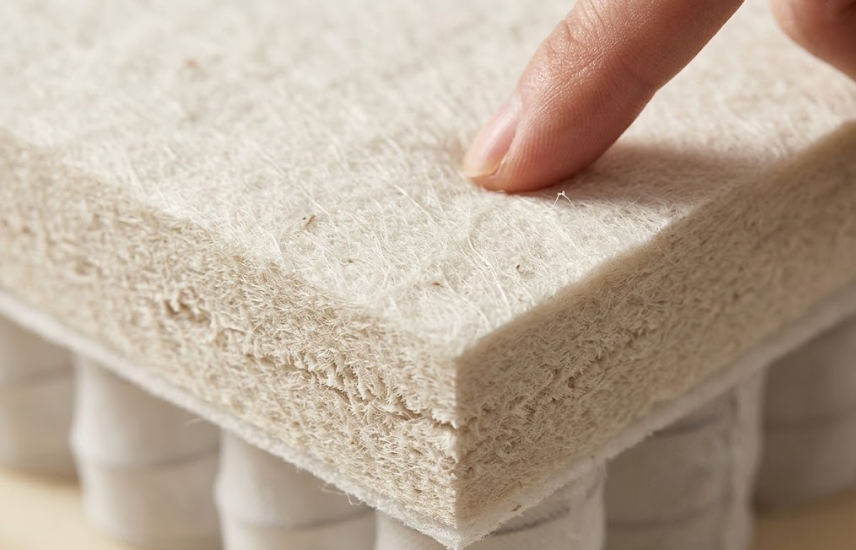
Breathable knitted fabrics, polyfiber padding, convoluted foam, slow-rebound memory foam, pocketed springs, and thermobonded hard cotton can all appear in a mattress construction. Their functions differ. A knitted cover affects the surface and airflow; foam layers shape pressure feel; springs and edge structures carry load. Choosing among them involves comfort and durability as well as any environmental objective.
Suisin Furniture states that it selects eco-friendly raw materials and lists those kinds of components in its mattress information. The phrase best mattress material is too broad to decide which option fits a particular design. A foam that changes pressure distribution and a reinforcement that protects an edge answer different questions. A component-level specification lets the buyer evaluate mattress materials before accepting a broad environmental claim.
Choosing the best mattress material also requires attention to replacement frequency. A mattress that loses support early may be replaced sooner, adding another product to the supply chain. Durability therefore belongs in the discussion, but it must be supported by relevant testing or use evidence for the selected construction. The presence of a particular foam or spring type alone does not prove a long service life.
Material choices may involve tradeoffs. A foam layer selected for pressure relief can differ from a denser support layer in feel and quantity. A breathable cover can change the immediate experience without determining the sourcing of every internal component. The environmental question must therefore be asked separately for each material.
Product teams can record why each material was chosen, allowing later environmental claims to be checked against the exact approved product construction. Combining unrelated functions under one “green” description makes it harder to verify either the comfort claim or the sourcing claim.
Ask What a Safety Credential Covers
Certificates and test references are often presented alongside environmental language. The scope matters: a claim may cover a foam component, a fabric, an input chemical restriction, or a manufacturing process rather than the complete mattress. The buyer should ask for the current document, the named product or material, and the standard or program it addresses. A logo without that context is difficult to interpret.
Suisin Furniture cites CertiPUR-US and OEKO-TEX-related foam safety credentials; scope needs confirmation. This is the company’s statement, not an independent verification of finished mattresses or components in its range. A purchaser can request the exact certificate or test document and confirm the supplier, material, validity period, and scope before repeating the claim in a product listing.
Safety and sustainability also need separate language. A restriction on certain substances can be relevant to material safety, while a claim about resource use or end-of-life handling requires different evidence. One document may address only one of these questions. Clear wording protects the buyer from turning a narrow credential into a broad promise it cannot substantiate.
Connect Construction to Service Life
Material architecture affects how the mattress feels and how it holds its shape. Multiple foam densities, pocketed springs, zoned support, and reinforced edges can be selected to meet pressure, motion, and structural requirements. Their contribution must be assessed in the complete bed, because layers interact. A comfortable surface can still sit above an unsuitable support core, and a strong core can be compromised by poor assembly.
Suisin Furniture describes options including convoluted wave foam, memory foam, breathable fabric, polyfiber padding, and hard cotton. Those are design choices with different roles, not interchangeable evidence of environmental performance. A buyer can compare an approved layer diagram with a sample, then ask what test or record supports any claim about durability, airflow, or material safety.
End-of-life language requires similar care. A product may be durable in use yet difficult to separate into materials after retirement; a component may carry a safety claim without demonstrating recyclability. Buyers can ask whether a claim concerns the material itself, the full mattress design, or a proposed disposal route. Where no supporting evidence is available, the product description can stay with the verified construction and avoid a broader environmental promise.
The most useful trend is greater precision in what a mattress materials claim actually means. Suppliers can identify the component, its functional role, and the evidence that applies to it. Buyers can then separate tested facts from broader goals that still need proof. A sustainable-material decision rests on a defined construction and claims that can be verified at the right level.