
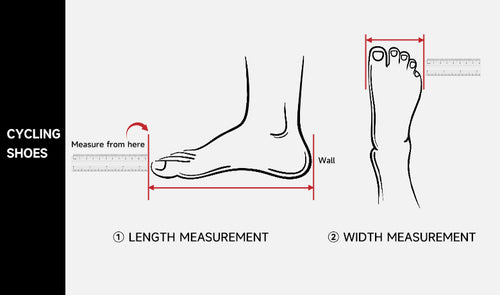
Power transfer begins with the way the foot is supported inside the shoe, not with sole stiffness alone. A rigid outsole can resist flex, but the benefit is reduced if the forefoot is compressed, the heel moves, or the foot shifts because the internal volume does not match its shape. Width functions as a load-bearing fit dimension; it is not merely a comfort adjustment made after length has been chosen.
It influences how the forefoot sits over the pedaling platform, how closure pressure is distributed, and how securely the foot can remain positioned while force is applied. Because feet with similar lengths can have different widths and instep volumes, a size label by itself cannot describe the quality of the shoe-foot interface.

Accurate measurement provides the dimensional basis for choosing the last and volume that allow structural stiffness to be used effectively. A width measurement also creates a cleaner basis for comparing models, because it prevents a rider from compensating for insufficient lateral room by increasing shoe length. That substitution can change heel position and toe clearance without actually solving the mismatch at the widest part of the forefoot.
Width Establishes the Forefoot’s Working Space
A useful foot width measurement is performed while the rider is standing, so the forefoot is assessed under body weight rather than in an unloaded position. The two widest points of the forefoot are marked and the distance between them is measured.
Both feet should be measured for length and width, with the larger foot used as the reference when checking the size chart. That procedure matters because width and length answer different questions. Length indicates how much longitudinal room the foot needs, while width indicates how much lateral volume is required across the forefoot.
If the last is too narrow, the upper and closure may compress the sides of the foot before the outsole becomes the limiting element. If it is unnecessarily wide, the forefoot may have more room to move laterally. Neither condition is desirable when the goal is a repeatable position over the pedal.
Greater sole stiffness cannot compensate for a last that leaves the forefoot compressed or unstable. The foot must first be supported in a shape that allows force to pass through the shoe without avoidable internal movement or localized compression.
Last Shape and Retention Work with Sole Stiffness
Differences between lasts make the role of foot width measurement concrete. Several Pro Race models use regular or compact formats, while Cruise is specifically listed with a wide last and wide toe box. Cruise is intended for wider feet and higher insteps and uses a rigidity-12 thermoformable carbon shell. The carbon sole is listed at 90 g, while one complete size-43 shoe is 252 g. Integrated sole ventilation and a breathable microfiber upper manage airflow around that broader fit volume.
A Wider Last Still Needs Rearfoot Control
Foot width measurement defines the room required, while the rest of the retention system keeps that room from becoming looseness. A Santic X ETIE micro-adjustable closure controls upper tension, an arch-support insole supports the foot, and an asymmetric heel cup limits rearfoot movement.
Those features illustrate the relationship between width and power transfer: the forefoot can have sufficient space while the closure and heel still stabilize the foot over a rigid platform. A wide last is not simply a more comfortable version of a narrow shoe. It is a different geometry that has to be paired with retention so the foot remains controlled during pedaling.
The Best Fit Is Secure Without Unnecessary Compression
Across categories, foot width measurement also matters in Santic’s flat-pedal Firmament because its wide last and wide toe box address lateral fit within a rubber-based pedal interface. It uses a wide last and wide toe box together with a VIBRAM rubber + TPU hybrid outsole, a precision dial, reverse-scale lining, TPU reinforcement, and heel containment.
The pedal interface differs from a carbon road shoe, yet the fit principle is the same: forefoot volume and rearfoot security are separate design variables. A rider can need more lateral room without needing more length or a looser heel.
For power transfer, Santic’s broader shoe architecture consistently combines sole stiffness with foot stability. Carbon appears in race-oriented soles, while dials, heel cups, arch support, and correctly matched width keep the foot positioned over the pedaling platform. Excessive forefoot compression is not evidence of efficient force transfer; it is evidence that volume and pressure may be poorly distributed.
Conversely, a roomy shoe that permits movement can weaken the sense of connection even when the sole itself is rigid. The target is secure retention around a measured foot width, with the last supplying lateral room and the closure controlling movement.
Foot width matters because the shoe can transfer force effectively only when the foot is supported in the correct lateral space. Standing measurement at the widest part of the forefoot, checking both feet, and using the larger result separates width from length before a model is chosen. Last shape then determines available volume, while closure systems, heel cups, insoles, and outsole stiffness determine how that volume is controlled.
Santic’s Cruise and Firmament examples show that wider geometry can be combined with firm retention rather than treated as looseness. The central relationship is simple: stiffness supplies the platform, but accurate fit determines how securely the foot can use it. Treating width as a measured input also prevents excess shoe length from being used as a substitute for the lateral room the forefoot actually requires.