
Residential users now consider more than battery capacity when selecting a storage system. Residential systems must meet current and future power demands while also being easily controllable after installation.
Fox ESS has built its residential portfolio around those practical requirements, combining scalable batteries, hybrid inverters, digital energy management, and a wider ecosystem of home-energy technologies.

Its market position provides additional context: S&P Global Energy ranked Fox ESS No. 1 globally in residential energy storage by MWh shipments for 2025.
Storage Is Becoming a Household Energy Decision
A storage battery can change how a household uses electricity because energy generated at one time can be stored for use later. That makes storage relevant to homeowners who want to make greater use of their solar generation and manage household electricity more deliberately.
The decision, however, extends beyond nominal battery capacity. Homeowners need to consider whether a system can accommodate changing energy requirements, whether installation is practical, and how easily the equipment can be monitored once it is operating.
Fox ESS approaches residential storage as part of a wider energy system. Its portfolio includes batteries, hybrid inverters, EV chargers, heat pumps, PV inverters, and digital management tools, giving homeowners a path from a basic storage installation toward a more connected energy setup.
Scalable Batteries Match Changing Household Needs
Household electricity demand does not necessarily remain constant. An EV, home renovation, additional appliances, or changing occupancy can alter how much energy a property needs over time. A battery that can expand therefore offers a different proposition from a fixed-capacity system.
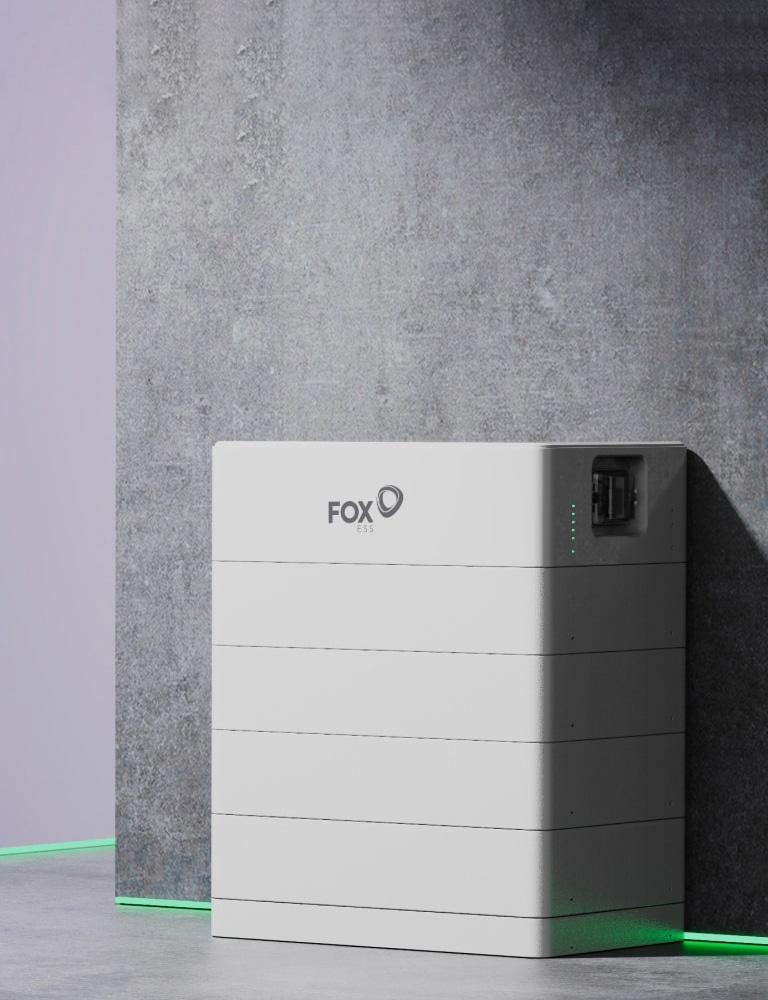
Fox ESS lists multiple modular battery families with expandable configurations. The EP6, for example, is listed with an energy range of 5.76–23.04 kWh, while the EP11 spans 10.36–41.60 kWh. The EQ series likewise provides expandable high-voltage configurations across several capacity ranges.
This modular approach can make a home storage battery easier to size around actual requirements. Instead of selecting the largest possible system from the beginning, homeowners can consider present demand while retaining a route toward greater capacity where the specific product configuration permits expansion.
That flexibility also benefits installers. Modular systems can provide more options when working with different property sizes and consumption profiles, reducing the need to treat every residential project as an identical battery installation.
High-Voltage Architecture Supports an Integrated System
High-voltage battery architecture is another defining feature across much of the residential range. Fox ESS identifies products such as the EP6, EP11, EQ3300, EQ4800, and EQ6000 Plus as high-voltage storage batteries, while highlighting high efficiency, easy installation, and expandable system design.
The battery is only one part of that architecture. Hybrid inverters provide the connection between solar generation, storage, household consumption, and grid interaction. Fox ESS offers hybrid inverter products designed to work with its high-voltage battery range, creating a more integrated approach to system design.
What this implies for householders is that the battery is no longer seen as a standalone device, but rather as an integral component of an integrated energy system. Installers might have a better idea of how to set up the system when they choose inverters and storage devices that are compatible with one another.
Installation Simplicity Matters Long After the Purchase
A technically capable battery still needs to be practical to install. Installation time, mounting options, system expansion, and access to technical documentation can influence the overall experience for both installers and homeowners.
Several Fox ESS battery products explicitly highlight easy installation and expandable design. The EQ4800, for instance, uses a modular configuration that can be expanded to 41.93 kWh, with additional batteries installed in series. Its documentation also describes a plug-and-play installation approach intended to save installers time.
Such design choices can have an effect beyond the initial installation. A system that accommodates modular expansion can remain relevant as household requirements change, while installer-oriented documentation can support commissioning and future service work.
FoxCloud Brings Energy Use Into Everyday View
A battery becomes much more useful when homeowners can understand what it is doing. FoxCloud 2.0 provides a centralized interface for monitoring energy production and consumption, controlling compatible devices, and reviewing trends across daily, weekly, monthly, and yearly periods.
Its software capabilities extend into more active energy management. FoxCloud 2.0 includes AI Mode, which the company says can analyze energy habits, PV output forecasts, and dynamic or time-of-use tariffs to optimize system performance. Users can also configure tariff plans through the platform.
For homeowners, this visibility turns energy storage from equipment hidden in a garage or utility area into something they can actively understand. It can help them see how their home produces and consumes electricity while giving them a clearer view of the system’s operation.
Why the Broader Fox ESS Ecosystem Matters to Homeowners
The appeal of Fox ESS extends beyond the battery itself. The company’s product portfolio connects storage with PV conversion, EV charging, heat pumps, and digital energy management. That breadth becomes increasingly relevant as households electrify more parts of daily life.
Market adoption provides another indicator of the proposition’s reach. S&P Global Energy ranked Fox ESS No. 1 globally in residential energy storage by 2025 MWh shipments, while the company also reported No. 1 positions in Germany and the UK.
For homeowners comparing a solar storage battery, the strongest case is therefore not based on one specification. Scalable capacity addresses changing demand, high-voltage architecture supports integrated system design, installation-oriented features can simplify deployment, and FoxCloud adds visibility and intelligent management.
That combination helps explain why Fox ESS has become a prominent choice in residential storage. Rather than treating a home storage battery as a standalone product, the company positions it within a connected energy system designed around how households generate, store, monitor, and use electricity.