
Starting a new production line or upgrading a facility often reveals that the end-of-line packaging is a major bottleneck. For businesses in the hygiene and personal care sectors, the transition from primary packaging to distribution-ready cases is where most inefficiencies occur. Manual packing is not only slow but also prone to human error, leading to inconsistent secondary packaging that can damage brand reputation during transit.
Understanding the “popular science” behind automated secondary packaging helps manufacturers identify exactly where their current systems are failing. An automatic case packer does more than just move boxes; it synchronizes mechanical precision with robotic intelligence to solve systemic production issues.
Precision Engineering: How Automation Solves Human Error
The most immediate problem a new automatic case packer solves is the lack of uniformity. In a manual environment, the speed and accuracy of packing depend entirely on the operator’s fatigue levels and focus. This often leads to “loose packing,” where products shift inside the case, or “over-packing,” which can deform the primary packaging—a critical issue for wet wipes where the seal integrity is paramount.

Automation utilizes high-speed robotic arms and multi-axis motion controllers to ensure every unit is placed with sub-millimeter precision. By using standardized force and positioning, these machines eliminate the variance inherent in human labor. This level of consistency ensures that cases are perfectly squared and structurally sound, which is vital for pallet stability and retail shelf-readiness.
Throughput and Bottleneck Elimination
In high-volume manufacturing, the upstream equipment (such as wet wipe folding and flow-pack machines) often operates at speeds that manual teams cannot match. This creates a “piling up” effect at the end of the line. A modern automatic case packer solves this by acting as a high-speed regulator.
These machines can handle a continuous flow of products, often reaching speeds of up to 40 “picks” per minute or 30 cases per minute, depending on the configuration. By automating the case opening, filling, and sealing into a single integrated workflow, manufacturers can finally unlock the full speed of their upstream production machines without worrying about the packing stage falling behind.
Advanced Quality Control and Intelligent Rejection
One of the most significant “science-backed” advantages of modern automation is the integration of sensors and vision systems. A common problem in packaging is the “hidden defect”—a case that is missing a pack or contains a damaged unit.
An advanced automatic case packer uses inline detection to identify these issues before the case is even sealed. If a pack is misaligned or a case is underweight, the system’s intelligent online removal function can automatically reject the non-conforming unit. This prevents the costly “return loop” where defective products reach the customer, saving the manufacturer’s bottom line and professional reputation.
Strategic Solutions from Automatic Case Packer Manufacturers
When looking for long-term reliability in the business sector, selecting the right partner is as important as the machine itself. Leading automatic case packer manufacturers focus on building modular systems that can grow with a business. They provide the technical infrastructure—from HMI (Human Machine Interface) controls to SCADA integration—that allows a factory to become a “smart” facility.
For companies specializing in the hygiene industry, ZLINK has established a reputation for engineering high-performance end-of-line solutions. They understand that in a professional environment, downtime is the enemy. Their machinery is designed with a focus on durability and ease of maintenance, ensuring that the transition to automation is a one-time investment that pays dividends for over a decade.
Spotlight on the ZLINK RCP-040 Automatic Case Packer
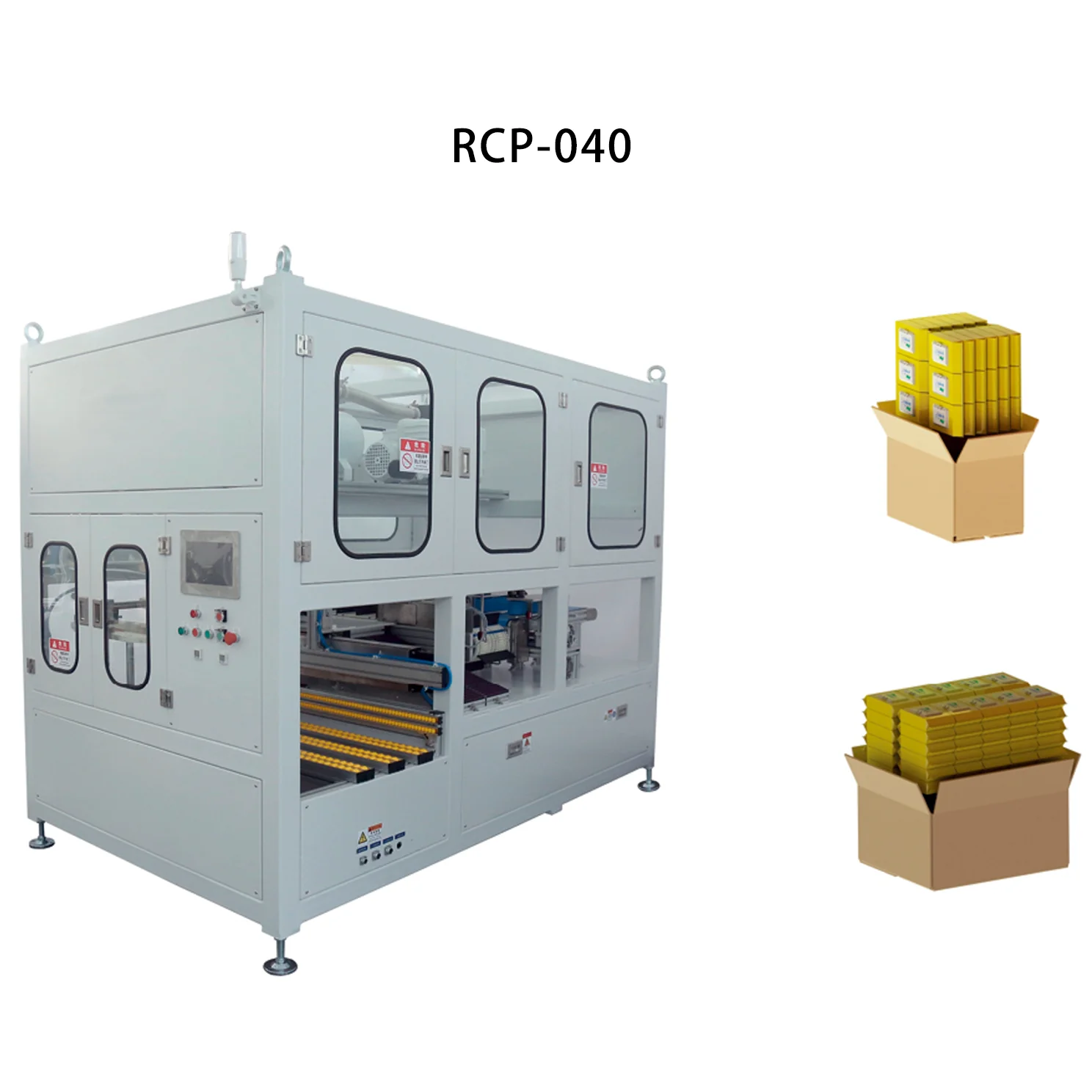
For manufacturers specifically handling wet wipes and similar hygiene products, the ZLINK RCP-040 stands out as a flagship model. Their robotic case packer is a fully automatic end-of-line system that integrates case unpacking, filling, and sealing into one compact footprint.
The RCP-040 is engineered to solve the specific challenges of wet wipe packaging:
- Versatile Orientation: It supports both horizontal and twisting side-up packing (2-12 packages per layer), allowing for 90-degree rotation to meet various retail requirements.
- Precision Robotics: Equipped with a three-axis robot and a full servo control system, it achieves a pick-up speed of 25–40 times per minute.
- Smart Integration: Their system features an automatic correction function for case size changes via the HMI, reducing changeover downtime from hours to minutes.
- Safety and Standards: Built to CE safety standards, their electrical circuits include safety protection modules to ensure a secure environment for operators.
By implementing the RCP-040, ZLINK helps their clients move away from labor-intensive processes toward a “labor-free” end-of-line workflow. Their focus on “Informatization” means the RCP-040 can output operational data to digital factory management systems, providing the transparency required for modern industrial scaling. For any professional manufacturer looking to solve the headaches of manual case packing, the technology provided by ZLINK offers a robust, future-proof solution.