
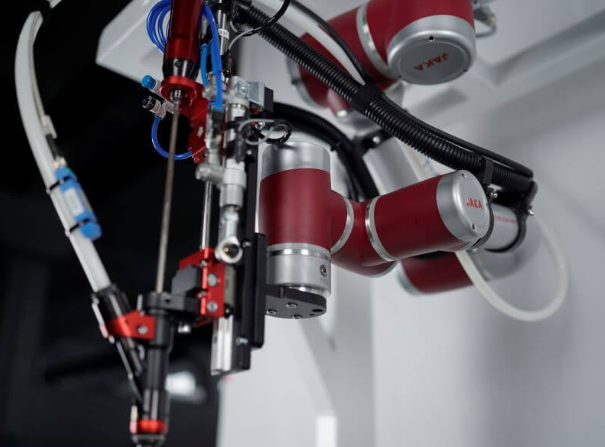
In the modern manufacturing landscape of 2026, the traditional image of a robot—bolted to the floor behind a heavy steel cage—is rapidly fading. Today, the “human-centric workspace” has become the gold standard for efficiency, where humans and machines share the same floor space, often working side-by-side on complex tasks. However, the success of this collaborative environment hinges on a single, critical technological pillar: safety through sensitivity.
Choosing a collision detection robot is no longer just about meeting basic regulatory requirements; it is about fine-tuning the interaction between machine power and human presence. By utilizing a flexible robot arm that can perceive its surroundings with high precision, facilities can eliminate bulky physical barriers and create a truly integrated production line. This guide explores the best practices for tuning sensitivity in collaborative environments, focusing on the advanced capabilities of the JAKA S5.
1. The Mechanics of Collision Detection
At its core, a collision detection robot operates by monitoring the torque and current in its joints. When the robot encounters an obstacle—whether it is a stationary part or a human worker—the resistance causes a spike in the required force. The robot’s controller detects this deviation from the expected “clean” path and triggers an emergency stop or a protective retreat.

In a human-centric workspace, “one size fits all” sensitivity is insufficient. If the sensitivity is too low, the robot may exert too much force before stopping, risking injury. If it is too high, the robot may trigger “false positives,” stopping every time it experiences a minor vibration or a slight change in payload, which cripples productivity. Tuning the flexible robot arm involves finding the “Goldilocks zone” where safety and throughput are perfectly balanced.
2. Tuning for Specific Work Zones
A key best practice in modern robotics is the implementation of zone-based sensitivity. Not every part of the robot’s reach carries the same level of risk.
High-Speed Zones: When the robot is moving through “open air” away from the human operator, sensitivity can be set to a standard level to allow for higher velocities.
Interaction Zones: When the robot enters a shared workspace—such as handing a part to a human—the collision detection robot parameters should be tightened.
Safety Planes: Advanced controllers allow for the creation of virtual “safety planes.” If the robot’s arm crosses these boundaries, the sensitivity automatically increases, or the speed decreases to ensure that any potential impact is well below the threshold of human pain or injury.
3. Payload and Inertia Compensation
Tuning sensitivity is not just about the human; it is about the robot’s own weight and what it is carrying. A flexible robot arm carrying a 5kg metal block has much higher inertia than one carrying a 500g plastic part.
A sophisticated system must be calibrated to account for the dynamic changes in payload. If the robot “knows” exactly how much weight it is carrying, it can subtract the expected torque required to move that weight from its total force readings. This leaves only the “external” forces—like a human touch—to be monitored. This prevents the robot from stopping itself simply because it accelerated too quickly while carrying a heavy load.
4. The JAKA S5: Perception-Enhanced Safety
According to the official product specifications from JAKA, the S5 includes integrated perception technology that enhances control and adaptability in industrial applications.
High-Precision Force Perception
The JAKA S5 features an integrated, built-in force/torque sensor that enables multi-dimensional force perception at the robot end (force and torque in x-y-z). This sensor is part of the robot’s force control capabilities as described on the official product page.
Force/Torque Sensor Parameters (as listed):
Force range: 200 N
Torque range: 24 Nm
Overall accuracy: 1% FS
Distinguishability: 0.1 Nm (torque) and 0.1 N (force)
Force Control Drag and Teaching
Sensitivity isn’t just for safety; it’s for ease of use. The JAKA S5 utilizes its built-in force sensor to enable “Force Control Drag.” This allows the operator to move the flexible robot arm by hand with minimal resistance. Because the robot is so sensitive to human input, it can be “taught” new paths simply by guiding it. In a human-centric workspace, this allows non-technical staff to adjust the robot’s routine on the fly without needing complex coding skills.
Rugged and Reliable Design
According to the technical parameters, the S5 is rated at IP65, meaning it is protected against dust and moisture. This is vital for industrial workspaces where safety sensors must remain accurate even when exposed to oil, mist, or debris. Furthermore, with a 954mm reach and a 5kg payload, it offers the perfect physical profile for shared workbenches, providing enough reach to be useful without being so large as to dominate the workspace.
5. Vision Integration and Safety Architecture
The S5 platform is designed to support integration with external vision systems offered in the broader JAKA ecosystem. When paired with a suitable vision solution, the robot can be programmed to coordinate positional awareness with other safety and task logic. The integrated force/torque sensor on the S5 provides real-time force feedback that can complement external perception systems, enabling responsive adjustments during operation.
The integrated force/torque sensor senses forces and torques in multiple axes (x-y-z), allowing for adaptable force control in diverse industrial scenarios. This foundation of sensing capability provides a basis for layered safety designs when combined with external vision or monitoring tools.
6. Force/Torque Sensing and Operational Assurance
The JAKA S5 is equipped with an integrated force/torque sensor that delivers multi-directional force perception at the robot end. According to the official specifications, the sensor offers a force range of 200 N, a torque range of 24 Nm, and overall accuracy of 1 % FS, with distinguishability values specified for both force and torque. These parameters support the robot’s force control functions and allow it to interact with its environment in a predictable manner.
With its integrated force/torque sensor providing accurate multi-axis feedback, the S5 equips engineers with actionable data to support safety planning, system optimization, and consistent operational control. The force sensor’s outputs can be accessed through the robot’s control and programming interfaces, making it possible to monitor and adjust force-related parameters according to application requirements.
Conclusion: The Future of Collaborative Harmony
Tuning a collision detection robot is the bridge between a dangerous machine and a helpful teammate. By utilizing a flexible robot arm like the JAKA S5, which offers built-in, multi-dimensional force perception and 0.1N distinguishability, facilities can create workspaces that are both incredibly productive and inherently safe.
In the human-centric factory of 2026, safety is not a barrier to speed—it is the foundation of it. When your robot can “feel” as well as it can move, the possibilities for innovation are endless.