
A field verification can stall at the pulse connector even when the instrument’s measurement range looks suitable. Phase configuration, signal compatibility and access to recorded results determine whether the proposed equipment can complete the job.
Buying a standard electricity meter therefore involves specifying the comparison it will perform, including the meter under test and its operating conditions. The purchasing brief can turn those constraints into acceptance checks for measured quantities, error limits, pulse exchange and communication. Each candidate then has a defined task before its headline specifications are compared.

The Verification Task Defines the Reference
DC, single-phase AC and three-phase AC installations require different reference configurations. A reference standard meter measures the comparison quantity; the meter under test produces the result being evaluated.
An electrical source establishes the operating condition where one is required. A reference instrument’s measurement capability does not establish that it can generate the voltage or current needed for the test.
The reported quantity narrows the requirement further. Checking accumulated energy needs an energy comparison over a defined interval, whereas observing current alone assesses only one electrical input. Active and reactive energy also represent different quantities. A specification that merely requests electrical measurement leaves the intended comparison unresolved.
Phase coverage matters at the same stage. A portable single-phase instrument and a three-phase reference serve different connection arrangements, even when both list voltage, current and energy functions. Required channels, AC or DC operation and the quantities being compared form the first filter for a purchasing shortlist.
A practical task description can name the installation, expected voltage and current, energy quantity and available meter output. Pulse constants link a pulse count to an energy quantity, making the configured constant part of the comparison itself.
That description separates a DC reference requirement from portable single-phase verification or three-phase testing, leaving the numerical specifications to be assessed within the appropriate branch.
Error Expressions Belong to Particular Ranges
A reading-related term changes with the measured value, while a range-related term depends on the selected range. RD and RG contributions therefore remain separate when evaluating a reference standard meter. Power uncertainty describes another quantity and cannot substitute for a voltage or current deviation specification.
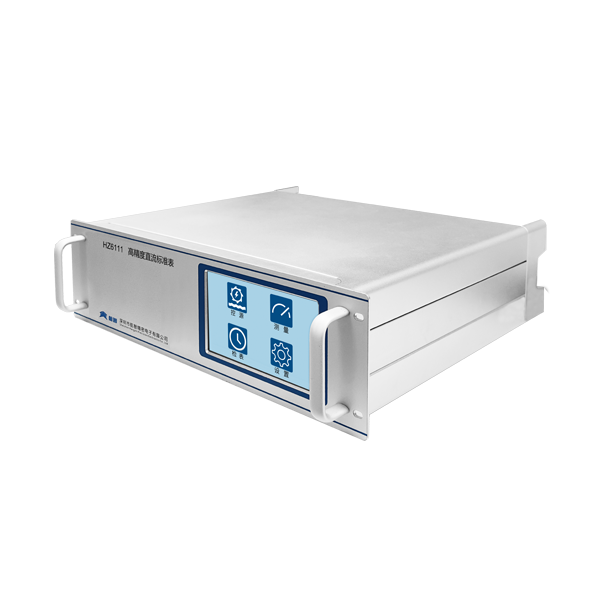
Separate voltage, current and power entries appear in Hangzhi’s HZ611 DC reference series. The HZ6111 voltage basic deviation is 0.003% RD + 0.002% RG; current basic deviation is 0.006% RD + 0.004% RG, with 0.01% power uncertainty. HZ6112 has corresponding expressions of 0.006% RD + 0.004% RG and 0.012% RD + 0.008% RG, with 0.02% power uncertainty.
The series measures voltage from 750 µV to 1200 V and current from 1 µA to 600 A for DC electricity-meter verification and DC-source calibration. A proposed standard electricity meter needs its intended test points mapped to the relevant ranges, rather than treating the series’ total coverage as one undifferentiated accuracy condition.
For three-phase work, TPT80 voltage, current, active-power and active-energy accuracy is ±0.05% RD under the applicable 30–400 V and 0.5–80 A conditions. Its voltage ranges are 200 V and 400 V, with current ranges spanning 0.5 A to 80 A.
Its voltage and current resolution is 0.005% RG, a separate description of measurement increments. These conditions allow a candidate to be assessed at the required operating points without converting its smallest displayed increment into an error guarantee.
Pulse Exchange and Deployment Complete the Comparison
A portable assignment adds current coverage, accessible pulse signals and a route for transferring results. The Hangzhi PSM family performs single-phase AC/DC verification with active and reactive energy measurement, energy-pulse input and standard-pulse output. The latter supports automatic pulse-constant setting, connecting the reference’s functions to the meter’s verification interface.
At 0.02% accuracy, the PSM600, PSM1000 and PSM1500 DC limits are respectively 600, 1000 and 1500 A; their AC ratings are 424, 707 and 1000 A at 0.05% accuracy. Matching the waveform to the corresponding rating avoids assigning a DC limit to an AC task. The PSM voltage limits are 1000 V DC and 707 V AC. RS232, RS485 and CAN provide communication options.
For a three-phase installation, TPT80 accepts pulse input to 50 kHz and supplies pulse output to 160 kHz. RS232 and RS485 are included, while CAN is optional. Pulse frequency limits and interface configuration belong in the acceptance record alongside the required measurement functions; a connector name alone leaves direction and configuration unspecified. TPT80 also specifies a TTL/CMOS-compatible standard-pulse output with load capacity greater than 20 mA.
Deployment also constrains the shortlist. TPT80 operates at 10–35°C, whereas HZ611 specifies 23°C ±10°C and no more than 85% relative humidity without condensation. HZ611 provides RJ45, RS232 and USB connections. A suitable measurement range cannot compensate for an incompatible receiving system or environmental conditions outside the selected instrument’s specified limits at the workplace.
Approval for purchase can remain pending until the intended interfaces and measurement functions are identified for the proposed instrument. For Hangzhi HZ611, PSM and TPT instruments, phase coverage and individual operating conditions determine which requirements can be met.
The remaining decision concerns documented fit for the intended comparison, including how pulse signals and readings will be received. Delivery acceptance during the commissioning process can then reproduce the specified task and check the agreed limits at the operating points that motivated the purchase.