
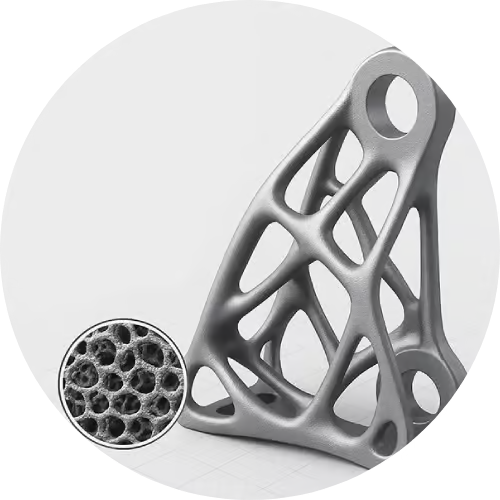
Manufacturers must balance cost, lead time, and flexibility when choosing a production method. A 3D metal printer may suit small production runs, complex geometries, or customized parts where traditional tooling is costly.
There is no universal order quantity at which metal 3D printing becomes the best choice. The suitable volume depends on part geometry, material, machine utilization, finishing requirements, and the cost of alternative processes. For engineering and procurement teams, the goal is to identify the production range where additive manufacturing delivers measurable value.
How 3D Printing Metal Parts Fits Different Production Volumes

Metal additive manufacturing builds components layer by layer from digital models. Selective laser melting (SLM) is a laser powder bed fusion process in which a laser selectively melts metal powder to create a solid part.
Because the process does not require a dedicated forming mold for each design, it can be useful when manufacturers need customized components or want to limit upfront tooling investment.
For prototypes and very small batches, the main advantage is design flexibility. Engineers can test a component, revise its digital model, and produce another version without commissioning a new forming tool. This is useful during product development, equipment upgrades, and engineering validation.
For small-batch production, additive manufacturing can support orders with varied specifications. A manufacturer may need several versions of a component for different machines or applications. Printing may be more practical than investing in dedicated tooling for every variation.
Medium-volume production requires closer analysis. Printing costs may remain higher per part than conventional methods, while tooling expenses are spread across more units as order volume increases. The break-even point varies by part design and manufacturing method. Companies should calculate it for their own components instead of relying on a universal quantity threshold.
Which Factors Determine the Suitable Batch Size
Order quantity is only one part of the decision. Component complexity can strongly influence whether additive manufacturing is competitive. Parts with intricate internal passages, lightweight lattice structures, or integrated features may be difficult to machine using conventional methods. Printing may reduce separate operations or assembly steps, improving the overall business case.
Tooling investment also matters. Casting molds, stamping dies, and specialized fixtures can require significant upfront expenditure. If a component is redesigned frequently, those costs may recur. Additive manufacturing can reduce this burden for suitable parts, although support removal, machining, and inspection may still be necessary.
Material selection affects both feasibility and cost. Different alloys have different powder prices, processing requirements, and performance characteristics. Manufacturers should confirm that the selected system supports the required material and that the finished component meets its mechanical and dimensional specifications.
Production scheduling is another consideration. A metal printer operates in builds, and output depends on more than the number of parts in an order. Build preparation, part orientation, machine availability, cooling, powder removal, and post-processing all influence delivery time. Grouping compatible components into one build may improve machine utilization, provided each part still meets its process and quality requirements.
Evaluating Equipment for Industrial Production
Equipment selection should reflect the intended parts, materials, and production targets. Buyers need to assess build volume, compatible alloys, laser configuration, process parameters, powder handling, and technical support. A machine’s maximum build rate alone cannot determine how many finished components it will deliver.
LiMN 3D specializes in SLM metal 3D printing equipment and customized processing services. Its offerings include metal printers, prototyping, printing services, technical support, and metal powders for industries such as aerospace, energy, mold manufacturing, and automation.
These features may interest manufacturers evaluating copper components and other suitable reflective materials. Actual production suitability depends on the specific alloy, component geometry, process settings, and quality requirements. Buyers should confirm material compatibility and the proposed machine configuration with the supplier before making an investment decision.
Calculating the Break-Even Production Volume
A break-even comparison separates initial costs from the cost of each accepted part. Use supplier quotations for the same drawing, material, quantity assumptions, and final inspection requirements.
Assume conventional production requires $6,000 in tooling and costs $20 per accepted part. Additive production requires $500 in setup and costs $75 per accepted part. These figures are illustrative, not actual quotations for either process.
Break-even quantity = (conventional initial cost − additive initial cost) ÷ (additive cost per accepted part − conventional cost per accepted part). This simplified expression applies when the denominator is positive and the assumed unit costs remain constant.
This is a simplified example. Actual costs may change with batch size, build layout, material consumption, production yield, finishing, and inspection. Buyers should use supplier quotations and representative part data for a realistic comparison.
Matching Production Strategy to Business Needs
The most suitable production volume depends on the economics and technical requirements of each application. Low-volume orders may benefit from reduced tooling investment, while complex designs can remain attractive at higher quantities. Conventional manufacturing may still be preferable for simple parts produced in large, stable volumes.
When evaluating 3D printing metal, manufacturers should compare realistic batch sizes, material requirements, and complete production costs before choosing a process. Trial builds can help validate production assumptions and reveal potential bottlenecks before larger orders are placed.
LiMN 3D provides metal additive manufacturing equipment and related technical services for industrial customers. Businesses can contact LiMN 3D to discuss application requirements and evaluate suitable equipment for their production goals.
Rather than setting a fixed volume threshold, manufacturers should use cost modelling and representative trial builds to identify where metal additive manufacturing offers the right balance of flexibility, quality, and production efficiency.