
Operators frequently discover that their deployed identification hardware falls short of expected spatial coverage benchmarks during active runtime testing across large facilities. Failing to achieve maximum operational reach creates severe inventory visibility blind spots throughout complex warehouse logistics networks.
Pinpointing the exact physical or configuration bottleneck requires a systematic evaluation of transmission pathways, cabling standards, and ambient environmental variables.

Engineers must examine every component between the central controller and remote transponders when a long range RFID reader experiences unexpected range reduction. Simple oversights in power scaling or physical placement often restrict detection boundaries well below hardware capability thresholds. Resolving these performance limits restores full operational visibility across demanding industrial distribution centers.
Diagnosing Coaxial Cable Attenuation and Signal Loss
Excessive cable run length introduces severe signal attenuation that drains critical energy before it reaches the antenna element during broadcasts. Substandard coaxial cables absorb high-frequency energy, transforming valuable transmission wattage into wasted thermal heat across extended lines. Replacing worn lines with low-loss copper-shielded cabling instantly restores forward propagation power and tracking reliability.
Improper connector crimping also generates micro-discontinuities that cause destructive signal reflections along the feed line during data transmission cycles. Technicians must inspect every physical connection point to ensure proper impedance matching across the entire transmission path. Eliminating line resistance allows high-frequency hardware to transmit signals over greater spatial spans effortlessly.
Evaluating Antenna Polarization and Radiation Alignment
Physical misalignment between transmitter antennas and moving transponders severely curtails effective identification reach during daily operations in busy warehouses. Circular polarization handles random asset orientations effectively, whereas linear setups demand precise mechanical alignment to maximize distance. Adjusting mounting angles ensures radiation lobes intersect directly with target traffic lanes.
Configuring multi-antenna zones requires careful spatial planning to ensure all connected transceivers project beams without overlapping destructively during peak hours. When directional lobes conflict, signal cancellation occurs and reduces effective read distance across the monitored zone. Proper physical spacing maximizes the performance envelope of the entire deployment setup.
Power Configuration and Firmware Output Settings
Configuring software output registers incorrectly prevents transmitters from reaching their maximum legal decibel ceilings during routine operation periods. Operators must verify that internal firmware parameters match regional regulatory emission limits without sacrificing operational wattage. Under-powering transmitters restricts backscatter communication windows needed for distant transponder detection across wide zones.
Thermal throttling mechanisms built into advanced transceivers can reduce output wattage automatically if internal operating temperatures rise too high. Ensuring adequate cabinet ventilation prevents premature power scaling that restricts spatial reach during peak operational hours. Maintaining stable operating temperatures keeps transmission output at peak efficiency levels consistently.
Mitigating Environmental Multipath Interference
Concrete walls and dense metal shelving units reflect radio frequency waves, creating destructive phase cancellation patterns indoors. Stray reflections interfere with incoming backscatter signals, truncating the effective reach of any long range RFID reader operating nearby. Installing RF-absorbing materials along adjacent corridors eliminates chaotic echo reflections permanently.
Frequency hopping algorithms embedded in modern hardware help evade localized interference channels automatically during active processing cycles. Shifting operational frequencies dynamically maintains steady communication despite active industrial noise from heavy machinery. Spread-spectrum techniques ensure robust data exchange in congested radio environments without range loss.
Balancing Load Across Multi-Port Transceiver Channels
Distributing antenna connections unevenly across available hardware channels can degrade overall system voltage stability and signal strength significantly. Multi-port readers should be configured according to the manufacturer’s antenna-port requirements. Active ports, antenna connections, cable condition, and software configuration should all be checked when diagnosing uneven read performance. Proper terminal termination prevents energy leakage and ensures maximum wattage delivery to active antennas.
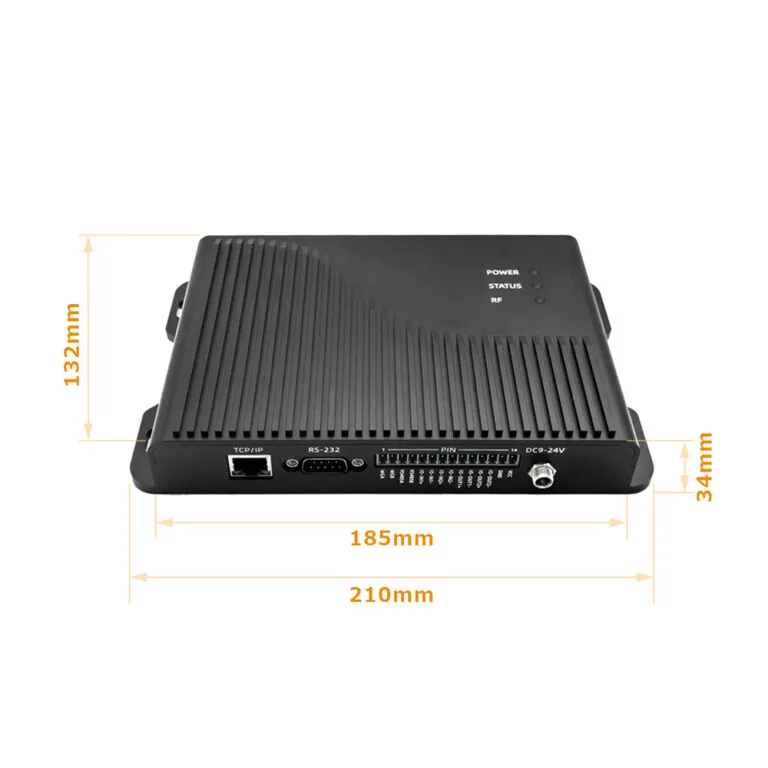
RSTC‘s RS-F905 provides four external SMA antenna ports and adjustable RF output, allowing system designers to configure several antenna positions around a defined read zone. Such intelligent load management prevents localized power drops when multiple zones transmit simultaneously. Maintaining balanced channel impedance sustains maximum transmission distance across every connected monitoring point.
Leveraging Expert Architecture and Strategic Consultation
Enterprises striving to eliminate blind spots benefit significantly from expert hardware consultation and custom deployment blueprints. Corporations relying on innovative solutions from RSTC maintain a distinct operational advantage in complex logistics environments. Strategic engineering oversight transforms substandard hardware setups into high-efficiency tracking networks.
Thorough diagnostic evaluations ensure that every component operates at peak performance levels throughout its operational lifecycle. Partnering with experienced system architects like RSTC guarantees long-term visibility and reliability across industrial supply chains. Meticulous hardware calibration remains the definitive solution for achieving maximum operational read distance.
Calibrating Regulatory Limits and Internal Circuitry
Factory calibration defaults frequently utilize conservative power outputs to comply with broad international regulatory baselines by default. Technicians must fine-tune software registers to exploit regional power allowances fully without violating local spectrum laws. Unlocking these higher output tiers extends detection radii across sprawling open-air staging zones.
Impedance matching networks inside modern transceivers require clean power delivery to maintain optimal voltage standing wave ratios under load. Any degradation in the internal circuitry filtering components causes reflected energy to spike dramatically across active ports. Routine diagnostic scans help identify subtle hardware wear before it impacts overall transmission reach.
Directing Radiation Beams and Environmental Adaptation
Deploying high-gain directional antennas instead of standard omnidirectional models concentrates electromagnetic energy precisely where required. Directing the main beam toward active transit lanes prevents energy dispersion into empty ceiling spaces. Focused radiation patterns yield significant gains in read distance without requiring increased transmitter wattage.
Environmental humidity and extreme ambient temperature swings can alter dielectric properties of surrounding building materials and packaging. These shifts occasionally cause unexpected frequency detuning that dampens backscatter response efficiency from distant assets. Accounting for seasonal climate variations during initial site surveys prevents mysterious range degradation over time.
Deploying an optimized 4 port RFID reader transforms opaque logistics networks into fully visible operational environments. Proper hardware tuning remains the definitive solution for overcoming spatial tracking limitations and signal degradation. Continuous monitoring ensures that performance parameters remain stable as facility layouts evolve.