
Home Techology The Mind’s Dance: Unraveling the Enigma of Storytelling in Our Brains

The Mind’s Dance: Unraveling the Enigma of Storytelling in Our Brains

by workdailyfilm
0 comment

Prepare to embark on a journey into the depths of our minds as we explore the captivating realm of storytelling. In this article, we delve into the enigmatic workings of our brains when we are immersed in tales that transport us to distant lands and ignite our imaginations.

A Symphony of Neurons: The Brain’s Response to Stories

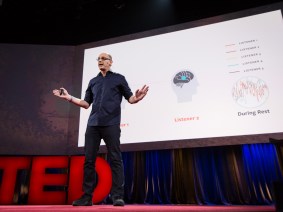
When we hear stories, an intricate symphony unfolds within our brains. Neuroscientist Uri Hasson takes center stage at TED2016, shedding light on this mesmerizing phenomenon. Through his research, he reveals that not only do storytellers and listeners share similar brain activity patterns but also that these patterns synchronize during moments of deep connection.

Hasson’s findings challenge conventional wisdom by demonstrating how stories have the power to bridge gaps between individuals, fostering empathy and understanding. As narratives unfold before us, specific regions in our brains light up like fireworks on a summer night – areas responsible for language processing and comprehension come alive with fervor.

But it doesn’t stop there; even more astonishing is how stories can transcend time and space within our minds. When listening to a story set in ancient Greece or futuristic galaxies far away, certain neural circuits activate as if we were experiencing those events firsthand. Our brains effortlessly transport us across dimensions as they seamlessly blend reality with fiction.

banner

The Artistry Behind Storytelling: A Multidisciplinary Tapestry

To fully appreciate the magic behind storytelling, one must embrace its multidimensional nature. It intertwines elements from various disciplines such as psychology, linguistics, anthropology, and even theater arts – creating an interdisciplinary tapestry that captivates both heart and mind.

Linguistic nuances play a crucial role in storytelling, as words are carefully chosen to evoke emotions and paint vivid mental images. The cadence of the storyteller’s voice, infused with a Pittsburgh English accent, adds an extra layer of charm that resonates deep within our souls.

Furthermore, the arts-focused education background of many masterful storytellers enhances their ability to craft narratives that captivate audiences. Drawing from their knowledge of visual aesthetics, music theory, and dramatic techniques, these skilled artisans create immersive experiences that transport us beyond the confines of reality.

The Power Within: Stories as Catalysts for Change

Stories possess an inherent power – they can shape our perceptions and inspire action. As we immerse ourselves in tales filled with triumphs and tribulations, our brains undergo profound transformations. Neuroplasticity allows us to rewire neural connections based on the stories we consume.

This transformative potential is precisely why stories have been used throughout history as catalysts for change. From ancient myths passed down through generations to modern-day social movements fueled by powerful narratives – stories hold immense sway over society.

A Final Bow: Celebrating the Wonders of Storytelling

In conclusion, storytelling is not merely entertainment; it is a fundamental aspect of what makes us human. Through its interdisciplinary nature and its ability to synchronize minds across time and space, storytelling has become an art form capable of fostering empathy and inspiring change.

So let us celebrate this wondrous dance between storytellers’ imaginations and our receptive minds – for within these moments lies the magic that connects us all.


You may also like

Leave a Comment

Soledad is the Best Newspaper and Magazine WordPress Theme with tons of options and demos ready to import. This theme is perfect for blogs and excellent for online stores, news, magazine or review sites.

Buy Soledad now!

Edtior's Picks

Latest Articles

Professional display systems require more than just a high-resolution screen to deliver smooth and reliable visual performance. Behind every large LED wall, commercial display, or stage screen, there is a control system responsible for processing signals, managing content, and ensuring accurate image output. An HDMI controller plays an important role in this process by receiving digital video signals, processing image data, and helping display systems present content correctly. In professional environments, it works as a bridge between video sources and display devices, improving signal management and operational efficiency. For modern LED applications, Kystar develops professional display control solutions that integrate video processing and LED screen management functions. These solutions are designed for applications such as live events, commercial displays, conference spaces, and creative visual installations. Understanding The Role Of An HDMI Controller In Display Systems An HDMI controller is a key component that manages HDMI input signals before they are displayed on professional screens. Unlike basic consumer devices, professional display controllers must handle complex signal requirements, including multiple input sources, different resolutions, and large-scale screen configurations. In a professional LED display system, the controller receives signals from devices such as media servers, cameras, computers, or playback equipment. It then processes these signals and converts them into a format suitable for the LED display system. This process ensures that images maintain proper timing, resolution, and synchronization. Without effective signal processing, large displays may experience issues such as image distortion, signal interruption, or inconsistent visual quality. HDMI Controller Supports Efficient Video Processing One of the main functions of an HDMI controller is video signal processing. Professional display projects often involve multiple video sources that need to be combined, switched, or adjusted during operation. A high-performance controller can help operators manage these signals more efficiently by supporting functions such as scaling, switching, and screen layout adjustment. These capabilities are especially valuable in applications where content changes frequently, including stage performances, exhibitions, and broadcast environments. Kystar’s two-in-one processor solutions combine video processing and LED sending functions, reducing the need for additional hardware devices. The KLSxC series supports flexible screen management, multiple input interfaces, and advanced layout functions for different LED display scenarios. Improving Image Quality For Large LED Displays Large LED screens require precise signal control because small processing errors can become noticeable on bigger surfaces. An HDMI controller helps optimize image output by managing resolution compatibility, signal timing, and content presentation. For example, when a 4K video source is connected to a large LED wall, the controller needs to process the signal correctly so the final image appears clear and stable. Professional controllers may also support advanced features such as multi-layer layouts, image scaling, and synchronization between multiple devices. These functions are essential for applications such as virtual production studios, command centers, sports venues, and high-end commercial displays, where image accuracy directly affects the viewing experience. HDMI Controller Enables Flexible Screen Management Another important advantage of an HDMI controller is its ability to simplify complex display configurations. Professional projects often use irregular LED structures, multiple screens, or creative display designs that require precise control. Modern controllers allow operators to adjust content placement, manage different display areas, and configure screen layouts according to project requirements. This flexibility helps designers create unique visual experiences without relying on multiple separate processing devices. For example, Kystar’s professional LED video controllers support multi-layer management, arbitrary layout adjustment, and different screen application scenarios. These features help users create more flexible display solutions for entertainment, commercial, and creative environments. Applications Of HDMI Controller In Professional Environments The application range of an HDMI controller extends across many professional display industries. In live entertainment, it helps stage teams manage real-time video content displayed on LED backgrounds and creative screens. In corporate environments, controllers support conference rooms, presentation systems, and large information displays by ensuring smooth content transmission. Retail stores and exhibition halls also use professional display control systems to create attractive digital experiences. Virtual production studios represent another growing application area. XR environments require accurate image processing and stable signal management because LED walls must work together with cameras, rendering systems, and production equipment. Choosing The Right HDMI Controller For A Professional Project Selecting the right controller depends on several factors, including screen size, input requirements, resolution standards, and application conditions. For small installations, a compact controller may provide sufficient processing capability. However, large-scale LED projects often require higher loading capacity, multiple signal inputs, synchronization functions, and flexible configuration options. Kystar provides different LED display control solutions designed for various project scales. The company’s KLS series covers different loading capacities and application needs, allowing system integrators to select suitable solutions based on specific display requirements. Conclusion An HDMI controller is a critical part of a professional display system because it manages signal processing, improves image quality, and simplifies complex LED display operations. It ensures that video sources can be delivered accurately to large screens while maintaining stable performance. As professional visual applications continue to grow, reliable display control technology becomes increasingly important. From stage productions and XR studios to commercial installations and creative LED projects, advanced controllers provide the foundation for high-quality visual experiences. With professional video processing technologies and integrated LED control solutions, Kystar continues to support customers in building efficient and reliable display systems for demanding visual applications.

All Right Reserved. Designed and Developed by workdailyfilm.