
Sound, image contrast, and concentration tell different stories around a suspected leak. Ultrasound can point to a pressurized escape, infrared imaging can reveal a surface pattern or, with suitable optics, a visible plume, and a portable gas detector can indicate the amount of a target gas reaching its sensor.
The useful distinction is what each instrument observes. An acoustic signal may point to a fitting without identifying the escaping gas. An image may show where a plume travels before anyone can reach it with a probe. A local reading answers a question about the sampled air, with the gas identity and units defined by the instrument.

What Escaping Gas Can Sound Like
Airborne ultrasound can come from turbulence as pressurized gas passes through a small opening. An acoustic instrument receives these high frequencies and presents a signal that can be followed toward a source. For a portable leak detector working on this principle, the measurement depends on the sound reaching the receiver.
Machinery can also produce high-frequency noise, while intervening equipment can obstruct or reflect sound. A response that gets stronger near a fitting narrows the area to investigate. Its strength alone cannot establish the identity of the escaping gas or how much has accumulated near the fitting. Weak signals can also occur when the pressure difference is small.
At a manifold, two neighboring connections may both appear to be candidates from a single listening position. Comparing the apparent direction from another position can help separate a source from a reflection. That comparison is still an investigation of the sound field, so a second method may be needed to confirm the gas.
Reading an Infrared Image
An ordinary thermal camera maps apparent surface temperature. Expansion of escaping gas or contact with a fluid at a different temperature may leave a visible pattern on nearby material. The pattern is an indirect clue. Insulation, sunlight, or a warm process surface can also create contrast without any gas escaping.
Seeing a plume calls for a different imaging capability. Optical gas imaging uses a spectral band in which the target gas absorbs infrared radiation. Visibility depends on the gas, the background, and the viewing conditions. An imaging-based portable leak detector can show plume movement when those conditions produce sufficient contrast, while the image by itself does not establish a local concentration.
Bringing a Sample to the Sensor
A concentration reading depends on which gas the instrument can sense and how the sample reaches it. Probe geometry can determine which recess the sensing tip can reach. A pumped design may collect the sample at an inlet away from the instrument body. In either case, a portable gas detector reports on the air that actually reaches the sensor.
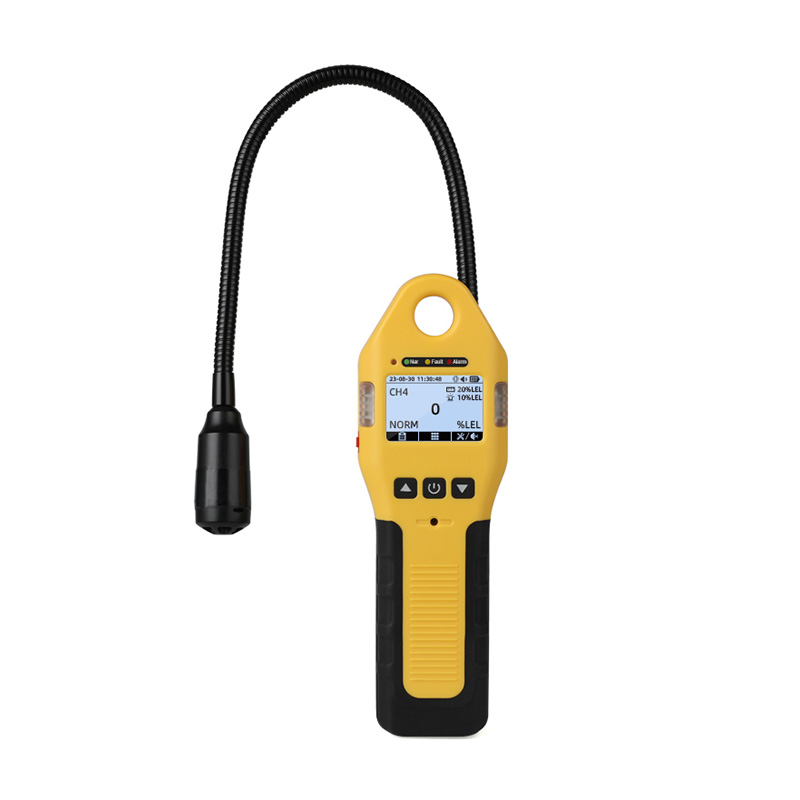
The pump on the Bosean BTYQ-BX103 draws air through an inlet for methane, propane, and butane checks. The BT-S100 uses a flexible gooseneck probe and natural diffusion. Its specifications list methane (CH₄) and propane (C₃H₈) as target gases. Compare the target gas and sampling method when choosing between the two instruments.
The inlet position belongs with the reading in any inspection record. A response close to a joint and another in moving air farther away may describe different samples even if the display uses the same unit. Measurements outside the listed 3–20% LEL range require an instrument specified for those concentrations.
When the Measurement Extends Along a Beam
Across an inaccessible section of pipe, the beam’s route matters as much as the point where it lands. The Bosean BT-YC101 uses reflected laser light to detect methane and reports the concentration integrated along the optical path in ppm·m. An obstruction that interrupts that path limits which part of the area can be observed.
Choosing a portable leak detector for a target across a gap therefore involves checking the output as well as the reach. The beam may intercept methane between the instrument and the reflecting surface without pinpointing its depth along that path. A probe reading near a connection describes a much smaller region, provided the connection is accessible.
On a line of equipment, two sight lines from different positions may intersect different parts of a plume. Their readings can help narrow the area for follow-up, but the sight lines need to be identifiable on the inspection record. The value alone cannot show which piece of equipment contributed methane to the beam.
Match the Search Tool to the Evidence Needed
A search across a bank of pressurized equipment and an investigation at one accessible joint place different demands on the instrument. Ultrasound can narrow an inspection route. Suitable imaging can show how a plume moves against its surroundings. A portable gas detector matched to the target gas can then characterize the sample at a stated location.
The documented Bosean options in this comparison address gas sensing. Their selection turns on whether the task calls for an accessible probe measurement or methane detection along a beam. For a probe, the target gas list, measuring range, and inlet design all matter. For a remote check, the optical path and the path-integrated unit belong on the same specification line.
An equipment list becomes useful when it states the evidence needed at each stage. A maintenance crew may first need a direction to investigate, then an observation of the release, and finally a concentration measurement where the work will occur. If a survey points to several fittings, local readings at accessible connections give the crew a basis for prioritizing follow-up.
SEO Title: Portable Leak Detectors: Ultrasonic, IR and Gas Sensing
Meta Description: Compare ultrasonic detection, infrared imaging, point sampling and optical path measurements to see what each portable leak detector can reveal.